Every industry understands the idea of performance. In school, performance meant grades. In sports, it meant winning. At work, it means results. We measure effort by outcomes not just by how much time or money was spent.
Marketing works the same way.
For years, businesses invested in advertising without always knowing what they were getting in return. Billboards, newspaper ads, TV commercials, you paid first and hoped for the best. But what if marketing worked like performance in sports or academics, where results were measurable and success was clearly defined?
That’s exactly what performance marketing is all about marketing where every click, lead, and sale can be tracked, measured, and optimized. In this article, we’ll simplify everything you need to know about performance marketing.
What Is Performance Marketing?
Performance marketing is a type of digital advertising where businesses pay only when a specific action is completed. Instead of paying simply to display an ad, you invest in measurable outcomes such as clicks, leads, signups, or sales.
Because your budget is directly linked to performance, this model is often called pay-for-results or pay-for-performance marketing.
What makes performance marketing especially powerful is its targeted approach. Campaigns are designed to reach people who are most likely to take action, using data and audience insights. Rather than focusing on surface-level metrics like impressions alone, the priority is driving real business growth through conversions, revenue, and return on investment.
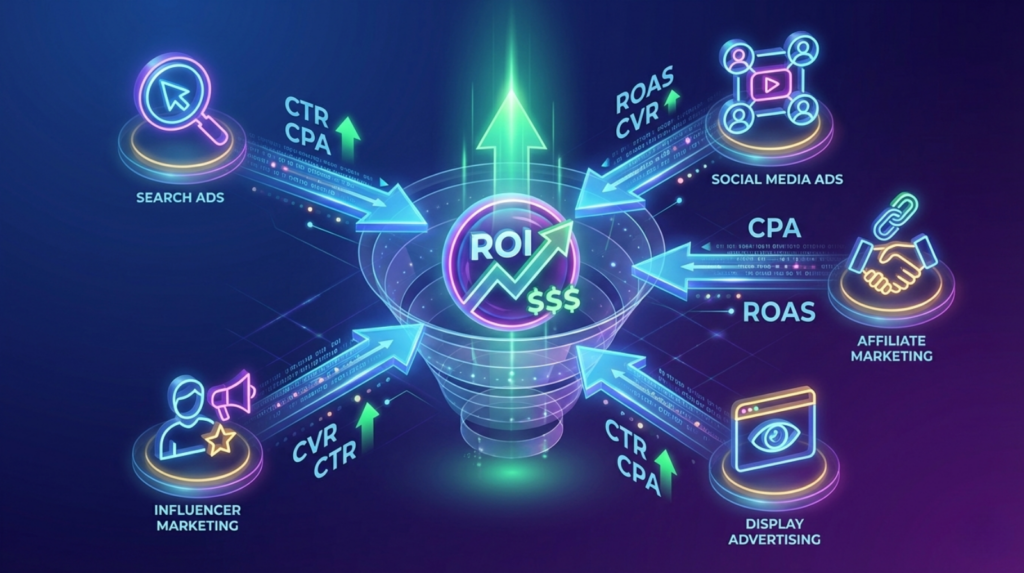
Channels for Performance Marketing
Here are the main channels you can use for your campaigns.
- Search Engine Marketing (SEM): Ads appear on search engines like Google and Bing when users search specific keywords. It’s one of the most direct forms of performance marketing because you’re reaching people actively looking for your product or service.
- Social Media Marketing: Paid ads on platforms like Facebook, Instagram, LinkedIn, TikTok, and X (Twitter). These ads target users based on their interests and online behavior, making them effective for building awareness and generating demand.
- Affiliate Marketing: Partnerships where affiliates promote your product and earn a commission only when they generate a sale or lead.
- Influencer Marketing: Brands partner with influencers who promote their products using trackable links or codes. Influencers earn a commission based on the sales or leads they generate, while businesses only pay for actual results making it beneficial for both sides.
- Display Advertising: Visual ads such as banners or images that appear on websites and mobile apps. These ads target specific audiences based on browsing behavior or interests and are optimized to drive measurable actions like clicks, signups, or purchases.
Benefits of Performance Marketing
Performance marketing offers several strong advantages for businesses looking to grow efficiently and sustainably.
Cost Efficiency (Low Risk)
Since you only pay for actual results, your budget is spent more wisely. If an ad doesn’t generate clicks, leads, or sales, you’re not wasting money on it. This pay-for-performance model reduces financial risk and ensures that your marketing investment is directly tied to outcomes that matter.
Measurable Results
One of the biggest strengths of performance marketing is transparency. Every click, lead, and sale can be tracked in real time. You can clearly measure return on investment (ROI), cost per click, or cost per acquisition making it easier to understand what’s working and optimize your campaigns accordingly.
Targeted Reach
Performance marketing platforms allow precise audience targeting based on factors like age, location, interests, search intent, and online behavior. This ensures your ads are shown to people who are more likely to take action, leading to better conversion rates and higher-quality leads.
Scalability and Flexibility
Campaigns can be adjusted at any time. If a particular ad or platform is delivering strong results, you can increase your budget to scale it. If something isn’t performing well, you can pause or modify it instantly. This flexibility makes performance marketing accessible for businesses of all sizes, whether you’re starting small or scaling aggressively.
Increased Brand Visibility
Although the primary focus is on conversions and revenue, performance marketing also strengthens brand awareness. Running ads across major digital platforms increases exposure, helping your brand stay top of mind while still driving measurable results.
What Key Metrics or KPI does a Performance Marketer focus on?
Here’s a breakdown of the KPIs that truly matter and why each one deserves your attention.
- Click-Through Rate (CTR): CTR (Click-Through Rate) is the percentage of people who click on your ad after seeing it. CTR tells you how engaging your ad is to the people who see it. A high CTR means your creative, copy, and targeting are aligned with what your audience wants. A low CTR is a signal that something’s off, either you’re targeting the wrong audience or your message isn’t resonating.
- Conversion Rate (CVR): This is where traffic meets results. Conversion rate measures the percentage of people who clicked your ad and actually completed the desired action , whether that’s making a purchase or signing up for a trial. A low conversion rate often points to a landing page problem, a mismatch between ad promise and page delivery, or poor audience targeting. Optimizing CVR is one of the highest-leverage activities in performance marketing.
- Cost Per Acquisition (CPA): CPA is one of the most important KPIs in performance marketing. It tells you exactly how much it costs to acquire one customer or lead. Your target CPA should always be grounded in your unit economic, for i.e., if your product earns ₹2,000 in profit per sale, your CPA needs to stay well below that to run a sustainable campaign.
- Return on Ad Spend (ROAS): ROAS tells you how much revenue you earn for every rupee spent on advertising. A ROAS of 4x means for every ₹1 spent, you’re generating ₹4 in revenue. It’s the clearest indicator of whether your campaigns are profitable. Different businesses operate at different ROAS thresholds depending on their margins.
Customer Lifetime Value (LTV or CLV): LTV tells you how much revenue a customer generates over their entire relationship with your brand. It’s a critical metric because it defines how much you can afford to spend to acquire a customer. If your LTV is ₹10,000, spending ₹2,000 to acquire that customer is a great deal. Without knowing LTV, you’re essentially flying blind on what your CAC should be.
Conclusion
The brands winning at performance marketing aren’t the ones with the biggest budgets, they’re the ones who understand their numbers and act on insights quickly. Success comes from strategy, tracking, and continuous optimization.
If all of this feels overwhelming, that’s completely normal performance marketing can get technical fast. That’s where we come in.
At Supersoft Digiads, we simplify the process so you can focus on running your business. From setting up accurate tracking to launching and optimizing high-converting campaigns, we manage the details while you focus on growth.
Think your campaigns could perform better? Let’s find out together.