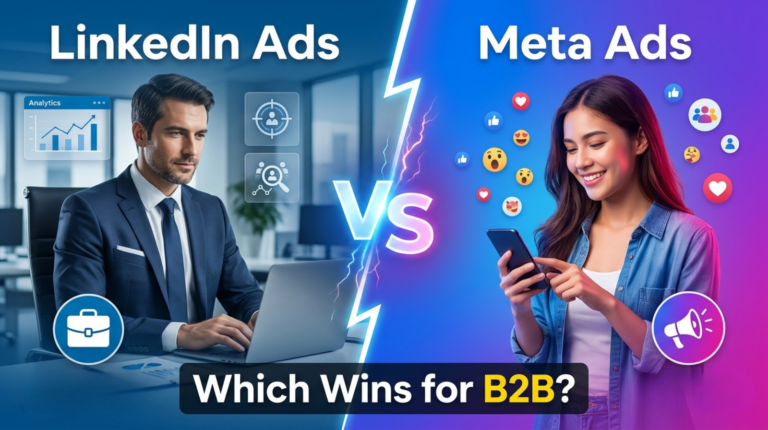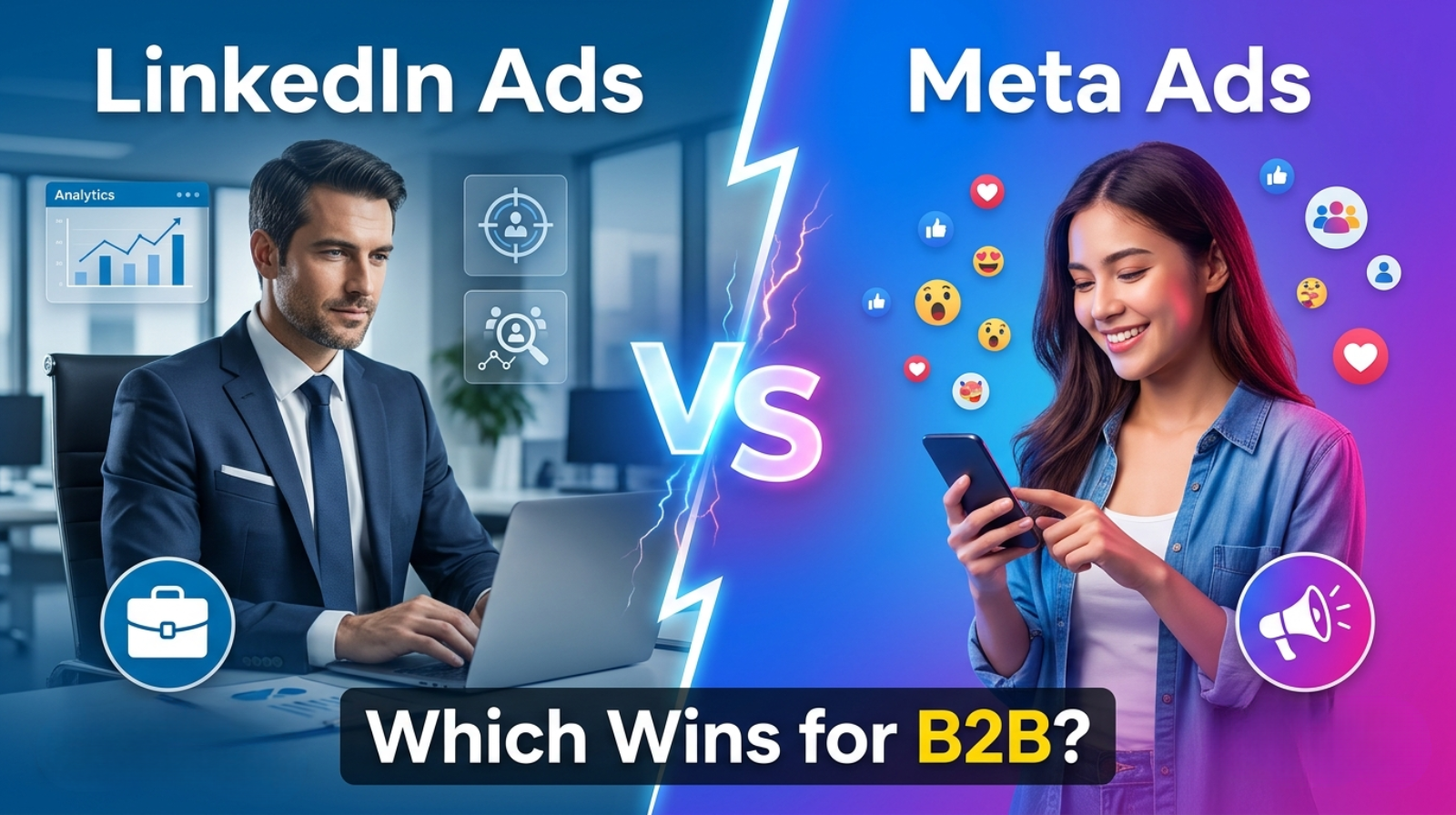
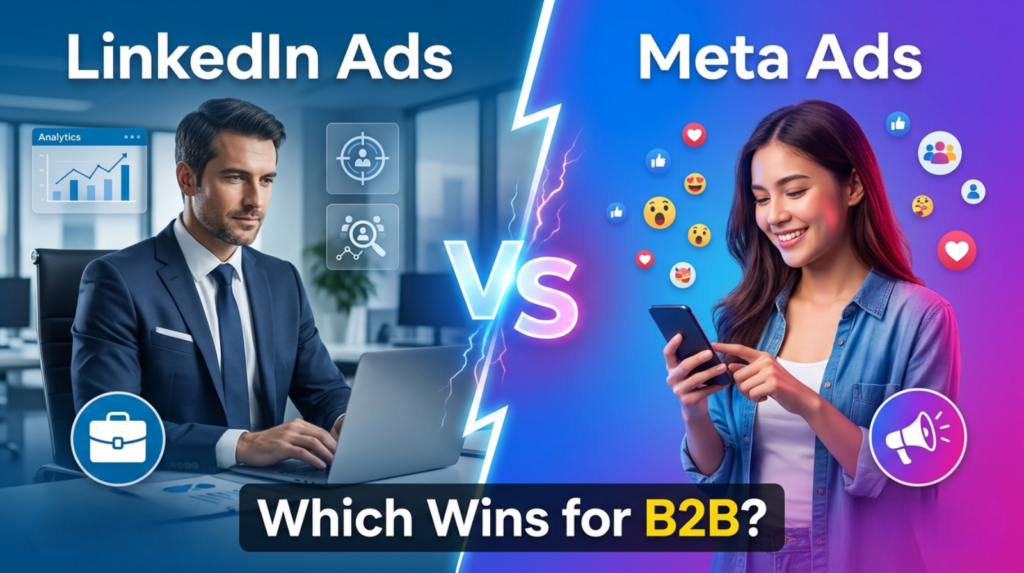
Should your next advertising campaign focus on LinkedIn Ads or Meta Ads? This is the question that comes to every business owner when deciding between the two platforms. While both LinkedIn and Facebook are powerful advertising tools that provide reach and results, including lead generation forms and retargeting, they differ significantly in terms of audience intent, targeting precision, and cost. This article will dive deep to give you a clear, honest answer on which platform wins for B2B and when.
1. Understanding the Audience on Each Platform
LinkedIn:
- Professional & Verified Audience: LinkedIn’s members actively keep their profiles up to date, meaning you’re reaching real professionals with accurate job titles, seniority levels, and company information.
- Direct Access to Decision-Makers: With 63 million decision-makers and 180 million senior-level professionals among its 1 billion+ members, 4 in 5 LinkedIn members are directly involved in business decisions.
- High-Value Pool: The audience is smaller compared to Meta, but every user is there with a professional mindset making them far more receptive to B2B messaging.
Facebook:
- Massive Reach: With 3 billion+ monthly active users, Meta gives you unmatched scale to put your brand in front of a vast audience at a relatively low cost.
- Mixed Audience Intent: Meta users are in a leisure mindset while using the app, so while the numbers are large, reaching the right professionals requires smarter targeting and creative strategy.
- High Screen Time: The average user spends nearly an hour on Meta’s platforms daily, giving your brand more opportunities to show up and stay memorable.
2. Audience Targeting:
LinkedIn:
LinkedIn’s targeting is built on verified professional data. You can target by job title, seniority level, company size, industry, skills, and employer name. Because users keep their profiles up to date for career purposes, the data is significantly more reliable than other platforms. LinkedIn also supports Account-Based Marketing (ABM) through its Matched Audiences feature, allowing you to upload target company lists and deliver ads directly to the right employees.
Facebook:
Meta’s targeting is behavior and interest-based rather than role-based. You can target by demographics, interests, online behaviors, and life events and build powerful lookalike audiences that let Facebook’s algorithm find new users who closely mirror your best customers. These tools work exceptionally well for consumer marketing and hold up reasonably well for B2B awareness campaigns, making Meta a strong choice for high-volume, top-of-funnel advertising.
3. Cost and ROI
Let’s talk money, what you should expect to spend, and how that translates into real campaign performance on each platform.
LinkedIn:
- LinkedIn ads typically range from $5 to $20+ per click, making it a pricier platform compared to others.
- Despite the higher costs, LinkedIn consistently delivers more qualified, high-intent B2B leads that justify the premium.
- Due to longer B2B sales cycles, ROI may take time to materialise, but the pipeline value it builds over time makes the investment worthwhile.
Facebook:
- Meta ads are significantly more affordable, with cost-per-click typically ranging from $1 to $3, making it an attractive option for businesses with tighter budgets.
- The lower cost per lead can be appealing, but lead quality is often mixed, meaning you may need a higher volume of leads to find the right prospects.
- For B2B campaigns, Meta works best when paired with a strong retargeting strategy, where lower costs can be leveraged to re-engage prospects who have already shown interest.
4. Ad Formats:
LinkedIn:
LinkedIn offers a variety of ad formats designed specifically for professional engagement. Sponsored Content appears natively in the professional feed, with video ads generating 2x more leads than static creatives. Lead Gen Forms take things a step further by pre-populating with a user’s LinkedIn profile data, converting 2 to 3 times better than sending traffic to an external landing page, removing friction and making it easier for busy professionals to respond to your offer.
For direct outreach, Conversation Ads land straight in a user’s inbox with open rates of 50–60%, making them one of the most effective tools for reaching decision-makers directly. Document Ads complement this by allowing prospects to download whitepapers and resources without ever leaving the platform, ideal for buyers who are still in the research phase of their journey.
Facebook:
Meta’s advertising is arguably more sophisticated on the creative side. Reels, Stories, carousels, Collection Ads, and Instant Experience formats give B2B marketers the canvas to build immersive brand narratives, making it a strong platform for visually driven, top-of-funnel campaigns.
5. The Buyer Journey:
LinkedIn:
LinkedIn excels at awareness and consideration stages when the audience is specific and professional. It’s the natural home for thought leadership content, case studies, product demonstrations, and direct outreach to decision-makers. Because users are already in a business mindset, they’re more receptive to evaluating a new vendor or booking a demo.
Facebook:
Meta performs best at the very top and very bottom of the funnel. For building initial brand awareness at scale, especially for companies breaking into new markets. Meta’s reach is unmatched at a fraction of LinkedIn’s CPM. And for retargeting prospects who have already shown intent, Meta offers cost-efficient re-engagement that keeps your brand front of mind throughout long B2B sales cycles.
Final Verdict: Facebook vs LinkedIn Ads?
At the end of the day, the LinkedIn vs Meta debate isn’t really about platforms, it’s about strategy. The platform is just the delivery mechanism. What drives results is knowing your audience, aligning your message to their mindset, building creativity that stops the scroll, and tracking performance all the way to revenue. The most successful B2B advertisers aren’t choosing one platform over the other; they’re using each for what it does best.
That’s exactly what we do at Supersoft Digiads. We specialise in paid social strategy for B2B businesses, aligning the right platform with the right funnel stage, reducing wasted spend, and increasing results. If you’re ready to stop guessing and start growing, let’s talk.