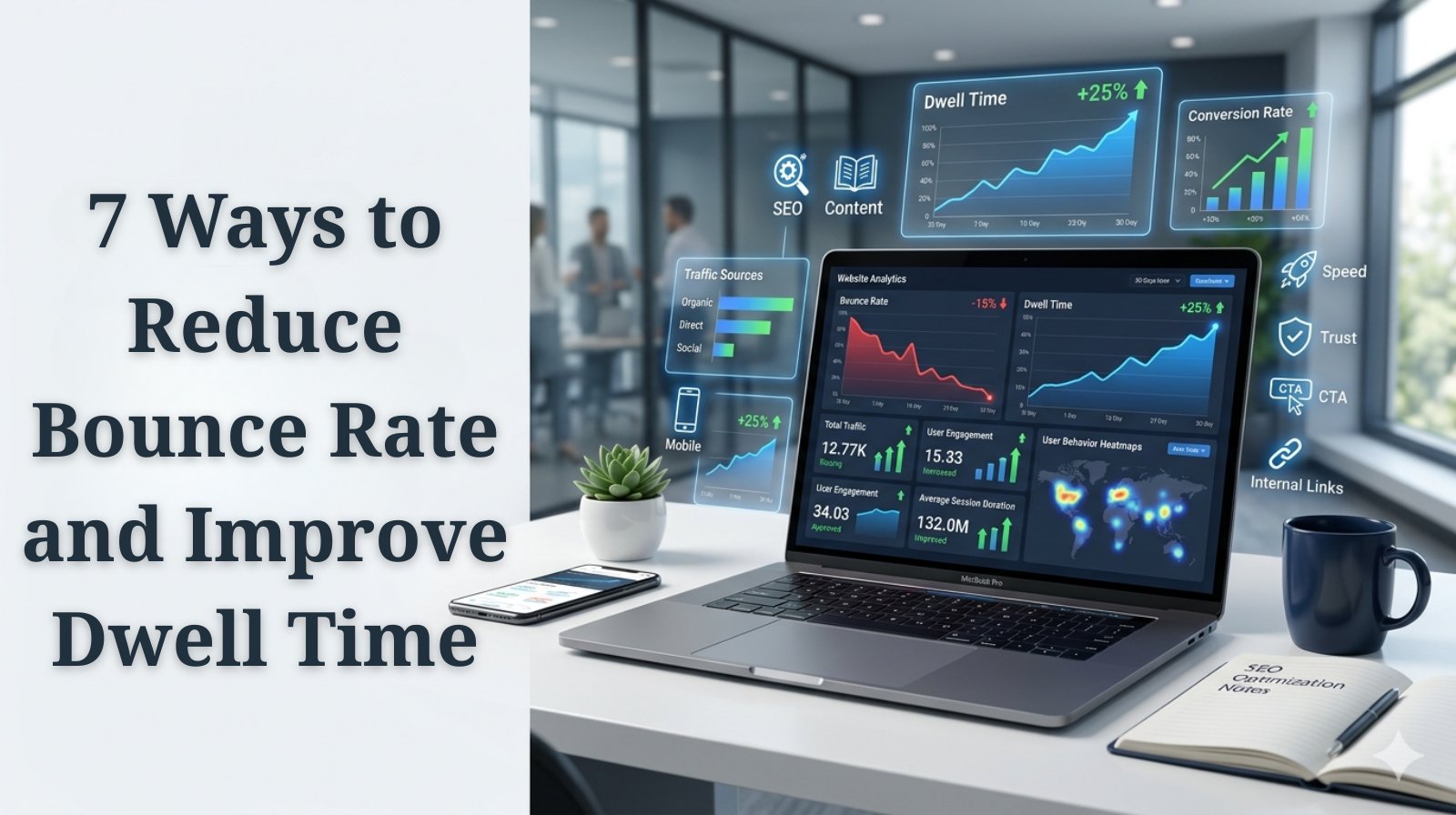
If you’ve visited your Google Analytics to check how your website is performing, you’ve probably come across two metrics that tell you exactly how users feel about your site: dwell time and bounce rate.
Improving these metrics by achieving a higher dwell time and a lower bounce rate means you’re in a much better position to engage your readers and encourage them to interact further with your content.
So if you’re ready to put in the work, here are 7 tricks that will help you reduce your bounce rate and keep visitors on your site longer.
What Are Bounce Rate and Dwell Time?
Before we dive into the fixes, it’s worth making sure we’re on the same page.
Bounce rate is the percentage of visitors who land on your website and leave without interacting with any other page. A high bounce rate generally signals that something is off, whether it’s your content, design, load speed, or targeting.
Dwell time is how long a visitor stays on your page before going back to the search results. Google pays close attention to this. If someone clicks on your page and returns to Google within 10 seconds, that’s a strong signal that your page didn’t satisfy their query.
Together, these two metrics paint a clear picture of whether your website is engaging, relevant, and worth a visitor’s time. Now, here’s how you can improve both.
1. Hook Them Fast
You only have the first 5 to 10 seconds to hook your audience; if you miss that window, they’re gone. Your page speed plays a huge role here; if your page takes 10 seconds to load, your visitor has already left before they’ve read a single word.
Put the important information first. Answer your reader’s question at the top, or open with something that immediately resonates with them. The first few words of your page determine whether someone stays or bounces. Pair that with clear subheadings and short paragraphs, and you create an experience that makes your visitor think – “This is exactly what I was looking for.”
2. Use Internal Links Strategically
Internal linking is one of the most underused strategies when it comes to reducing bounce rate. A well-placed internal link guides your visitor to related content, keeps them spending more time with your brand, and creates a natural journey through your site rather than a dead end.
Every piece of content you publish should lead the reader somewhere to a related blog post, a service page, a case study, or an FAQ. Don’t make them go looking for what’s next; bring it to them.
And here’s the bonus, internal linking doesn’t just help your visitors, it helps Google too.
3. Optimise for Mobile Users
Let’s be honest, more and more people are discovering websites through their phones than their desktops, and that number is only growing. A poor mobile experience sends them straight back to Google, and once they’re gone, they rarely come back.
The issues are often small but damaging: text that’s too tiny to read without zooming in, images that blow up and break the layout, buttons that are impossible to tap accurately. Any one of these frustrations is enough to lose a visitor in seconds. It’s also worth remembering that mobile users often come with different expectations than desktop users. They want things faster, simpler, and easier to navigate with one thumb. Understanding those differences and designing your site around them can reduce your bounce rate significantly.
4. Design for Readability, Not Just Looks
Beautiful websites are great, but if your visitor lands on a wall of dense text, clashing colours, or a layout that’s hard to follow, they’ll leave, even if your content is excellent.
Break your content into digestible sections using clear headings and subheadings. Keep paragraphs short, add bullet points where they make sense, and choose fonts that are easy to read across all screen sizes. Make sure there’s enough white space so the page feels breathable & not claustrophobic.
Good structural design makes it easy for visitors to pull out the information they’re looking for without having to work for it. And when reading feels effortless, people keep moving forward through your page instead of clicking back.
5. Set a Clear Call-to-Action
Calls-to-action should be relevant, visible, and aligned with what your visitor actually came for. Skip the generic labels nobody feels compelled by “Submit” or “Click Here.” Instead, write something specific and benefit-led, like “Get My Free Consultation” or “See How We Can Help Your Business Grow.” That small change in wording makes a significant difference in whether someone acts or bounces.
Placement matters just as much as the wording. Don’t save your CTA for the very bottom of the page, where only the most committed readers will ever reach it; place them strategically throughout your content, at the natural points where a visitor is most likely to be ready to take the next step.
6. Build Trust
If a visitor lands on your page and sees nothing that signals credibility, doubt sets in fast. Trust signals are small but powerful elements that tell visitors, “you’re in the right place, with the right people.” Think client testimonials, recognisable brand logos, star ratings, and industry accreditations.
These don’t need to be flashy; they just need to be visible. Place them above the fold, near your CTAs, or alongside any section where you’re asking visitors to make a decision. The moment a visitor trusts you, their willingness to stay, read further, and take action increases significantly. People don’t just buy from businesses they find; they buy from businesses they trust.
7. Set the Right Expectations With Your Meta Titles and Descriptions
A high bounce rate sometimes starts before a visitor even lands on your page. If your meta title or description promises something your content doesn’t deliver, visitors feel misled — and they leave immediately.
Write accurate meta descriptions, not just clickable. Here’s what to keep in mind:
- Be specific — tell the reader exactly what they’ll find on the page
- Match your content — your page must deliver what the meta promised
- Target the right audience — the right visitor with the right expectations is far more likely to stay
When people click through knowing exactly what to expect, they’re already halfway to being engaged.
Wrapping Up
By putting these tips into action, you’re not just improving your dwell time and reducing your bounce rate; you’re making sure your content is more refined and more accurately matches what your ideal customer is actually searching for. And that’s precisely the kind of thing that search engines want to see more of.
Every small improvement you make sends a signal to your visitors and to Google that your website is worth their time. Do that consistently, and your analytics will start telling a very different story.
And if you’re not sure where to start, Supersoft Digiads is here to help. From SEO to content strategy and performance marketing, we help UK businesses turn their websites into something visitors actually want to stay on. Get in touch today for a free consultation.