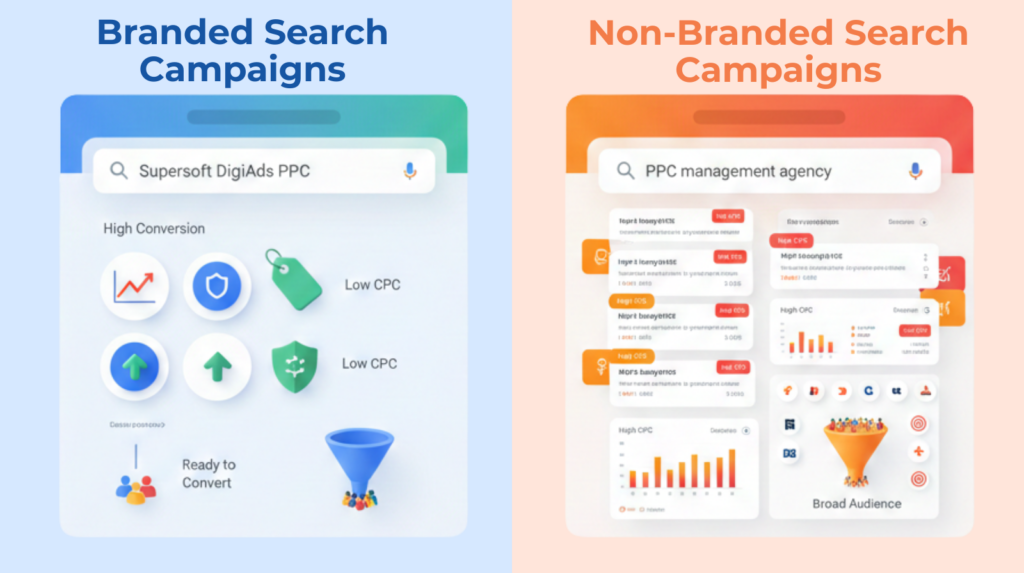
When setting up PPC campaigns, one of the first decisions businesses face is whether to target branded or non-branded keywords.
Branded campaigns target people who are already searching for your company name. They typically deliver higher conversion rates and lower cost-per-click because these users already know who you are. In many cases, they are actively signalling purchase intent. However, branded search has a natural ceiling. You can only capture as many people as are searching for your brand each month. Increasing the budget does not increase demand.
Non-branded campaigns, on the other hand, target a much larger audience of people who don’t yet know your brand. These users are searching for services or products rather than specific companies. This is where growth opportunities exist. However, non-branded campaigns require completely different strategies, expectations, and budget allocations compared to branded search.
When you mix branded and non-branded keywords together, your data gets messy, Google’s automated bidding doesn’t know what to optimize for, and you end up making growth decisions based on blended metrics that don’t reflect what’s actually working.
In this guide, we’ll break down exactly why separating branded and non-branded Google Ads campaigns is essential for anyone serious about scaling profitably.
Understanding the Difference: Branded vs Non-Branded Keywords
Before you can split your campaigns effectively, it’s important to understand what makes branded and non-branded keywords fundamentally different.
Branded keywords
Branded keywords include your company name, product names, or any variation of your brand. The defining factor is intent: people searching these terms already know you exist. They may be existing customers, previous website visitors, or prospects who discovered you through word-of-mouth or another marketing channel. In most cases, these users are at the bottom of the funnel and ready to take action in the near term often within days.
Non-branded keywords
Non-branded keywords are generic search terms related to your industry or services. These users have a problem or need, but they don’t yet know that your business is the solution. At this stage, you’re competing for attention against every other company in your market. These searchers are typically at the top of the funnel, and conversion may take weeks or even months as they research, compare, and build trust.
How performance typically differs
The difference in intent shows up clearly in performance metrics:
- Branded keywords often convert at rates between 10% and 25%, driven by strong familiarity and trust.
- Non-branded keywords usually convert between 1% and 5%, as users are still exploring their options.
Cost reflects this difference as well:
- Branded keywords often cost between $0.50 and $3 per click, due to lower competition.
- Non-branded keywords can range from $5 to $50+ per click, as multiple businesses compete for visibility in a crowded marketplace.
How to Identify Them in Your Account
Start with your Search Terms Report in Google Ads. This shows exactly what people typed before clicking your ad. Download it and sort through to see which searches contain your brand name versus generic industry terms.
Next, review your active keywords list in the Keywords tab. You can start differentiating between branded and non-branded keywords using these patterns:
Branded keywords include:
- Your company name or variations of it (e.g., “Nike,” “Canva,” “Spotify”)
- Your unique product names
- Common misspellings of your brand
- Your brand combined with terms like “login,” “pricing,” “reviews,” or “contact”
Non-branded keywords include:
- Generic industry terms
- Problem-focused queries
- Solution searches without any brand mention
- Competitive comparison terms without your brand
- “Best [category]” type keywords (e.g., “best graphic design apps)
When to Use Branded vs Non-Branded Keywords
The real question isn’t which one to choose, it’s when to use each. To grow effectively, you need both strategies working together, but for very different reasons and at different stages of your business growth.
When to Prioritise Branded Keywords
Budget is Limited
When resources are tight, branded keywords give you the most bang for your buck. With lower CPCs and higher conversion rates, you can maintain a profitable presence without breaking the bank. This is especially important for small businesses or startups that need to stretch every dollar.
You Need Quick, High-Converting Traffic
Branded keywords deliver immediate results with minimal effort. If you need to hit short-term revenue goals or generate quick wins, branded campaigns are your best friend. They convert fast because these searchers already trust you & just need that final nudge.
You’re Already Generating Brand Awareness
If you’re running other marketing activities such as social media campaigns, content marketing, PR, or podcasts, people are already hearing about you. You’ve done the hard work of getting your name out there, and branded campaigns make sure you don’t lose those potential customers to competitors at the last moment.
Protecting Your Territory
Even if you rank organically for your brand name, competitors may still bid on it. Branded campaigns ensure your ad appears at the very top of search results, pushing competitors down and helping you control the narrative. You’re effectively protecting your brand real estate in search results.
When to Prioritise Non-Branded Keywords
You Want to Grow Beyond Your Current Audience
Branded keywords are limited by existing awareness. Non-branded keywords open the door to a much larger audience of potential customers who haven’t heard of your business yet. This is where sustainable growth comes from. If your goal is to expand market share and reach new audiences, non-branded campaigns put you in front of people who would otherwise never find you.
You’re in a Competitive Market
If you’re competing against established players, waiting for people to search your brand name isn’t a strategy. Non-branded keywords allow you to intercept customers during their research phase, before they’ve committed to a competitor, giving your business a chance to be considered early in the decision-making process.
Testing New Markets or Products
Launching a new product or entering a new market? Non-branded keywords help you test demand and messaging without relying on brand equity you haven’t built yet. You can learn what resonates with cold audiences and refine your approach before scaling up.
Building Long-Term Brand Awareness
Non-branded campaigns introduce your business to people who don’t know you exist. Over time, these searchers become familiar with your brand, and some will eventually come back and search for you directly. It’s a longer play, but it builds sustainable growth by expanding your brand footprint.
Finding the Right Balance Between Branded and Non-Branded Keywords
- Start with Strategic Allocation:
Branded and non-branded campaigns shouldn’t be treated as competing priorities. They serve different purposes and both require dedicated attention within a well-structured strategy. Running both campaign types in parallel allows you to gather meaningful performance data and understand how each contributes to your overall business goals. It’s also important to avoid favouring one over the other based on surface-level metrics such as conversion rates, as branded keywords will naturally appear more efficient due to higher intent. - Align your budget with your business goals.
In growth mode, it often makes sense to allocate a larger share of spend around 70–80% to non-branded campaigns, accepting higher costs as part of acquiring new customers. When the focus shifts to efficiency or market defence, a more 50-50 balanced split can work better. Your brand campaigns should always run lean to capture high-intent demand without overspending on conversions you would likely achieve organically. - Monitor and Adjust Regularly:
Monitor performance regularly and review results every month. Watch for changes in branded search volume as awareness grows, and be prepared to reallocate budget when data consistently shows one approach better supporting your current objectives. Remember that the right balance isn’t what worked last quarter, it’s what your current business reality and competitive landscape demand today.
A Final Word
In our experience at Supersoft DigiAds, clients who implement this split see immediate improvements in campaign efficiency, reporting clarity, and decision-making. Separating branded and non-branded campaigns provides a clearer understanding of where results are coming from and how budgets are truly driving growth.
Effective Google Ads performance isn’t about choosing one over the other. It’s about recognising that branded and non-branded searches serve different purposes and require different strategies. When each is managed independently, businesses gain better control, more accurate insights, and a more sustainable path to scaling their advertising investment.
Want help optimising your PPC strategy? Supersoft DigiAds is here to help your business reach its online potential. Reach out to us or give us a call.