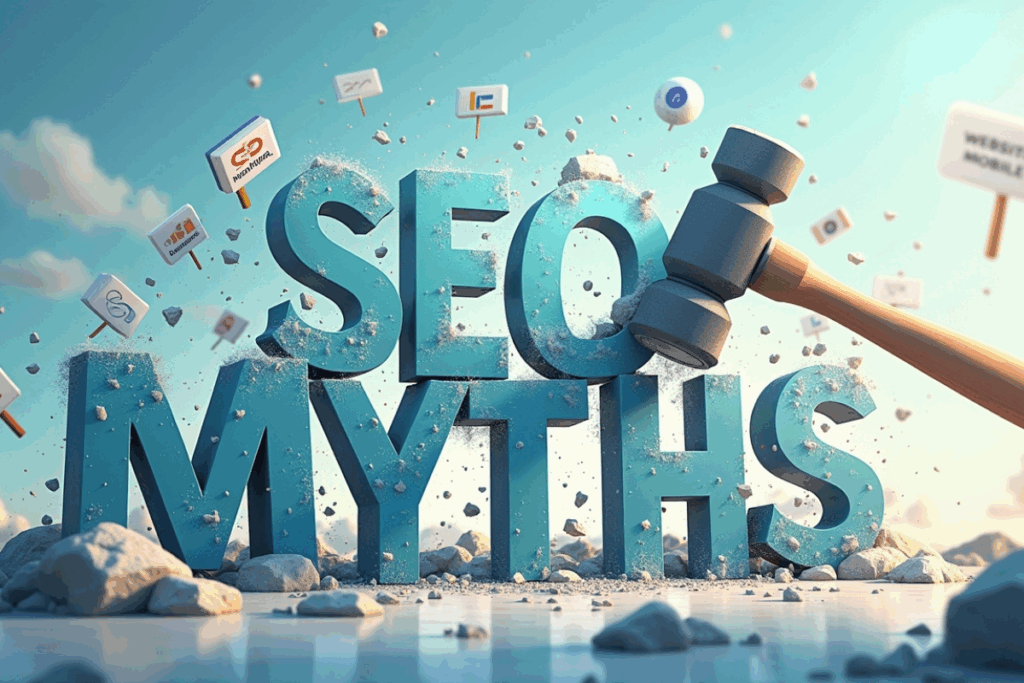
No one truly knows the exact workings of Google’s search algorithm, which often leads to confusion and misconceptions about SEO. Google uses over 200 different factors to determine how a website ranks. Amid these numerous signals, certain outdated or incorrect beliefs often slip in and mislead even the most well-meaning digital marketers.
Many people still follow these SEO myths, thinking they help when in reality, they can damage your website’s visibility and performance. To improve your rankings and attract more relevant traffic, it’s important to recognise and avoid these misconceptions.
Below are 8 common SEO myths that you should stop believing. Debunking them is essential if you want to boost your site’s presence in search results and grow your organic traffic effectively.
Why It Is Essential to Understand SEO Facts vs. Fiction.
Understanding the difference between SEO facts and myths is crucial, as falling for misinformation can lead to wasted time, misdirected efforts, and even serious consequences like lost traffic or search engine penalties.
SEO is a constantly evolving field. Google makes thousands of updates to its ranking algorithm every year, meaning that strategies that once worked might now be ineffective or even penalised. Many common myths stem from outdated practices or misinterpretations of how search engines actually work.
To succeed in the ever-evolving SEO environment, it’s important to stay informed and make strategic decisions based on current, credible information. Always verify SEO advice using trusted sources, such as Google’s official guidelines (Search Essentials), and cross-check with data from reputable industry experts. The more accurately you understand what truly influences rankings, the better your chances of building a strong, lasting online presence.
Myth #1: Using More Keywords On Your Page Will Help Your Page Rank Better
Many people still believe that simply repeating a keyword over and over will boost a page’s rankings. This idea dates back to SEO’s early days, when search engines relied heavily on keyword frequency to determine relevance, so repeatedly adding the same term, known as keyword stuffing, often led to higher rankings. However, today, overusing keywords can actually hurt your rankings by making the content appear spammy and less valuable to readers.
Your goal with using keywords should be to clarify what your page is about. Today’s algorithms evaluate how effectively your content meets a user’s needs by examining context, relevance, and overall user experience, rather than tallying keyword occurrences. Instead of spamming in keywords wherever you can, focus on placing them thoughtfully in your page title, headings, opening sentences, and any spot where they naturally fit. If your material is well-organised, informative, and genuinely helpful, it can rank strongly even if the exact term shows up only a few times.
Myth #2: SEO Is a One-Time Effort
Many people believe that SEO is a one-time task; once their website is optimized, it will continue to rank well forever. This belief often comes from seeing short-term results after an initial round of optimization, leading to the false assumption that the website will rank forever.
In reality, SEO is an ongoing process. Even if your site performs well initially, those results won’t last without consistent effort. Search engines constantly update their algorithms, and your competitors are actively improving their own websites. Over time, they can outpace you in key areas like content freshness, backlink acquisition, and technical improvements.
Without regular updates and ongoing SEO maintenance, your one-time investment loses its impact. To stay visible and competitive, SEO needs to be treated as a continuous strategy, not a one-time fix.
Myth #3: All backlinks are good
In the early days of SEO, you could boost rankings simply by building as many links as possible whether on online forums, directories, or any other site. Today, however, quality far outweighs quantity.
Search engines only value links from trustworthy, relevant sources, think respected industry blogs, authoritative websites, or natural mentions from businesses in your niche. These high-quality backlinks act like endorsements, signaling to Google that your content is credible and worthy of a higher ranking.Conversely, links from spammy or unrelated sites can actually harm your credibility and even incur penalties. Buying bulk backlinks or chasing every available link opportunity won’t help; it risks downgrading your site’s authority.
Instead, focus on creating exceptional content that others want to reference. Engage in guest posting on reputable industry platforms and cultivate partnerships within your field. When you build genuine relationships and produce valuable resources, quality backlinks will follow naturally.
Myth #4: Mobile Optimization Doesn’t Matter
Mobile optimization is more important than ever. With Google’s shift to mobile-first indexing, it now primarily evaluates the mobile version of your website to determine rankings. On top of that, over 60% of web traffic today comes from mobile devices, making it essential to deliver a smooth and responsive mobile experience.
If your website isn’t optimized for mobile, you’re not only providing a poor user experience but also risking lower search rankings across all devices. Google prioritizes websites that are mobile-friendly, meaning they load quickly, adjust well to different screen sizes, and are easy to navigate on smartphones and tablets. Sites that fail to meet these standards often suffer in both visibility and user retention.To ensure your site performs well, regularly test it using tools like Google’s Mobile-Friendly Test and PageSpeed Insights. These can help identify and fix issues affecting your mobile usability.
Myth #5:SEO Is All About Ranking #1
Many believe the ultimate goal of SEO is to rank #1 on Google. While ranking high is helpful, it’s not the most important factor. What really matters is getting the right visitors, people who are actually interested and likely to convert. A page ranking at #3 that brings in quality leads can be far more valuable than a #1 ranking for a broad or irrelevant keyword. Simply being at the top doesn’t guarantee clicks or results.
Search results are constantly changing and tailored to each user based on location, search history, and preferences. Even if you’re ranked #1 today, you can be outranked tomorrow if others keep improving their SEO.
Also, being #1 doesn’t always get the most clicks. What matters more is how relevant your title and description are, and whether your brand is trusted by users.The true goal of SEO is not vanity metrics it’s to attract relevant traffic, drive conversions, and support your business growth.
Myth #6: You Should Only Target High-Traffic Keywords
While it might seem natural, targeting high-traffic keywords is the best way to get more visitors. After all, more searches should mean more potential traffic, right?
Not exactly. High-traffic keywords are usually very broad and extremely competitive. That means a lot of websites are trying to rank for them, especially big players with strong domain authority. Focusing only on these popular keywords also ignores the value of moderate-traffic, niche-specific keywords. Many people mistakenly believe that these keywords are useless because they don’t get as many searches but that’s not true. These long-tail keywords are often easier to rank for and attract visitors who are actively looking for exactly what you offer.
For e.g.
Let’s say you run a dental clinic in Bangalore.
- Targeting the keyword “teeth whitening” might seem appealing, but it’s broad and competitive. Someone searching for that term could be looking for home remedies, products, or just general info. On the other hand, a keyword like “best professional teeth whitening clinic in Bangalore” has lower search volume but is very specific.
Myth #7: Domain age is a Ranking Factor
Many people assume that older domains automatically rank higher on Google just because they’ve existed longer. This myth likely exists because long-standing websites often perform better in search, but not because of their age alone. In reality, Google has confirmed that domain age is not a direct ranking factor. A 10-year-old site with poor content, few backlinks, and low engagement won’t outrank a newer site that’s consistently publishing valuable content and earning quality backlinks.
Older websites may seem to have an edge simply because they’ve had more time to build authority, trust, and link equity, all of which are legitimate ranking factors. Ultimately, what counts is the quality, relevance, and trustworthiness of your site, not how long your domain has been registered.
Myth #8: Meta Tags Don’t Matter Anymore
Some people believe that meta tags, especially meta descriptions no longer play a role in SEO. This misconception often stems from the idea that since meta descriptions don’t directly impact search rankings, they’re not worth the effort.
Your meta title is still considered a major on-page ranking signal, and your meta description serves as a preview of your page in search results. A clear, relevant description helps users quickly understand what your page offers. When people see content that matches their intent, they’re more likely to click. This improves your click-through rate (CTR), which in turn supports your SEO performance over time.
High-quality titles and descriptions also contribute to brand visibility and recognition, making your listings stand out among competitors in search results.In short, while meta tags alone won’t determine your rankings, they play a key role in attracting the right audience and encouraging them to visit your site. Make sure to optimize them as part of a well-rounded SEO strategy.
Conclusion
Don’t fall for outdated SEO myths or shortcuts that promise quick wins; they often cause more harm than good. Instead, focus on the fundamentals: creating valuable content, building trust, optimising for user experience, and following ethical, proven strategies.
To stay ahead, make continuous learning a priority. Follow credible SEO resources, including Google’s official documentation and trusted industry blogs. At Supersoft Digiads, we provide expert digital marketing services to support your SEO efforts and regularly publish insightful articles to help you stay up to date with the latest best practices.