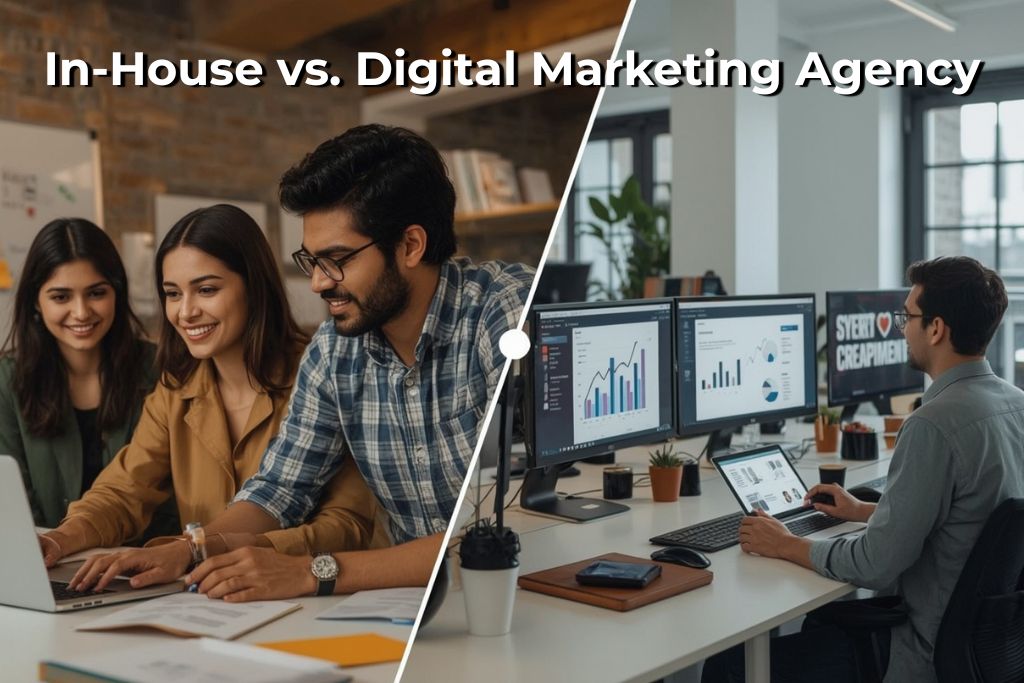
Thinking about scaling your business but unsure how to approach marketing? One of the biggest dilemmas companies face is deciding whether to build a full-time in-house marketing team or partner with an external digital marketing agency. At first glance, this might seem like a purely financial decision comparing salaries versus agency fees. But in reality, the impact runs much deeper.
The choice you make shapes everything from your company’s speed and efficiency to its ability to adapt and grow. The wrong decision can drain your budget, slow down progress, and stall momentum for months. The right one, however, can unlock a clear path to sustainable, exponential growth.
If you’ve been wrestling with this choice, this guide will walk you through the key factors to consider. By the end, you’ll have a clear understanding of which path in-house or agency best matches your current business pace, resources, and ambitious growth targets.
What Is an In-House Marketing Team?
An in-house marketing team consists of employees within a company who handle all or part of its marketing activities using the company’s internal resources. This team is responsible for a wide range of marketing tasks, including content creation, graphic design, SEO, social media management, and campaign strategy. The size and structure of an in-house team depend on factors such as the company’s goals, budget, required expertise, and overall business size.
A great example of a successful in-house marketing model is Netflix, the streaming giant. Netflix’s marketing team works at the speed of content production, ensuring that promotional assets are ready as soon as new shows or movies are released. Netflix’s in-house team is also renowned for its witty, timely, and humorous social media content, turning viral moments into powerful brand engagement and keeping the brand culturally relevant.
Pros of an In-House Marketing Team
- Deep Brand Alignment An in-house team already understands your brand’s voice, values, and unique selling points. This deep familiarity allows them to create campaigns that are highly on-brand and cohesive, ensuring every piece of communication reinforces your core brand promise. Because they are involved in internal meetings and closely connected to other teams, they also understand customer pain points and internal challenges.
- Greater Control & Transparency With an in-house marketing team, you maintain full oversight of all marketing activities, budgets, and timelines. Since the team reports directly to the company, you have complete control over strategy, creative direction, and spending decisions. This transparency makes it easier to track performance and ensure resources are allocated effectively.
- Strong Internal Collaboration In-house marketers are immersed in your company culture and work side-by-side with other departments such as product development, sales, and customer service. This close collaboration gives them a deeper understanding of customer needs and business priorities, leading to campaigns that are more aligned with your overall strategy.
- Faster Operations Because they are part of the company, in-house teams don’t face the communication layers or delays that can occur when working with an external agency. Their direct access to key decision-makers creates a rapid feedback loop, allowing them to quickly adapt to new opportunities, challenges, or market shifts.
Cons of an In-House Marketing Team
- Limited Expertise It’s often not financially practical for a company to hire top-tier specialists for every marketing discipline. This means in-house employees are often required to wear multiple hats, handling a variety of tasks like SEO, content creation, PPC, videography, and data analytics. While this can make them versatile, it also means they may lack deep, specialized expertise in certain areas, potentially leading to gaps in strategy or execution.
- Higher Operational Costs Building and maintaining a capable in-house team requires significant financial investment. Beyond salaries, there are ongoing expenses such as employee benefits, office space, software licenses, marketing tools, and continuous training. Even if individual salaries seem lower than agency fees, the combined overhead can be substantially higher over time, especially as your marketing needs grow.
- Challenges with Scaling Expanding an in-house team to meet growing demands is slow, expensive, and resource-intensive. Recruiting, onboarding, and training new staff take time, which can be a major hurdle during periods of high demand, such as a major product launch or seasonal campaigns. Until new hires are fully integrated, the existing team may become overworked, leading to missed opportunities or reduced campaign quality.
- Risk of Stagnation Over time, an in-house team can become too focused on internal perspectives, losing touch with the evolving external market. This inward focus may lead to campaigns that feel strong internally but fail to resonate with the target audience or keep pace with industry trends. Without fresh, outside ideas, creativity can plateau, and marketing efforts may begin to feel repetitive or outdated.
What Is a Digital Marketing Agency?
A digital marketing agency is a specialized firm that helps businesses grow by providing a wide range of online marketing services, such as SEO, social media management, content creation, paid advertising, and more. These agencies employ teams of experts across different marketing disciplines, working together to plan, execute, and optimize campaigns for their clients.
Since agencies work with multiple businesses across various industries, they gain broad experience and valuable insights into what works in different markets. This exposure allows them to stay ahead of emerging trends and technologies, ensuring their clients benefit from the latest strategies and tools to stay ahead.
Pros of Working with a Digital Marketing Agency
- Fresh Perspectives As external partners, agencies bring an objective, independent viewpoint to your marketing strategy. They can identify gaps, challenge internal assumptions, and offer creative solutions informed by their experience. This “fresh set of eyes” often sparks innovative ideas and strategies that an internal team may overlook, helping your brand stay relevant and competitive.
- Broad Expertise Agencies employ specialists across every key marketing channel from SEO and content marketing to paid ads, social media, and design. This diverse, multidisciplinary talent pool gives your business access to high-level expertise without the need to hire individual full-time specialists for each role. As a result, you get comprehensive, well-rounded marketing strategies.
- Time Savings Outsourcing your marketing to an agency frees up valuable time for you and your internal team. Instead of managing day-to-day marketing execution, you can focus on core business operations. Agencies handles campaign planning, execution, and optimization, which reduces managerial overhead and often leads to faster campaign launches.
- Adaptability & Flexibility A digital marketing agency provides the flexibility to scale efforts up or down based on your business needs. For example, if a particular marketing channel isn’t performing, the agency can quickly shift resources and budget to another channel without the need for internal restructuring. This ensures your marketing strategy remains agile and responsive to changes in the market.
Cons of Working with a Digital Marketing Agency
- Shared Attention Since agencies work with multiple clients at the same time, your projects are essentially sharing resources and attention. If the agency takes on a particularly demanding client or faces staffing challenges, your campaigns may not receive 100% focus. This is why it’s essential to choose an agency with adequate capacity and a proven track record of delivering consistent results to all its clients.
- Initial Learning Curve Unlike an in-house team, an agency starts with no prior connection to your brand. It takes time for them to fully understand your company’s mission, products, target audience, and culture. Typically, there’s an initial onboarding period of 4–6 weeks during which the agency learns about your business and sets up systems and strategies. While this phase is temporary, it can delay the start of impactful campaigns.
- Potential Miscommunication Working with an external team introduces an extra layer of communication, which can sometimes lead to missed details or misunderstandings. Because agencies manage multiple clients, there’s a risk of misaligned expectations or project delays if briefs and feedback aren’t crystal clear. To avoid this, it’s vital to have structured communication processes and a dedicated point of contact on both sides to ensure alignment and efficiency.
- Less Direct Control When you outsource marketing to an agency, you lose direct, hands-on control over the day-to-day execution of campaigns. Instead, you rely on performance reports, scheduled updates, and meetings to stay informed. This can sometimes cause delays in resolving issues or acting on opportunities as they arise. While agencies strive to align with your vision, their execution ultimately happens without your constant oversight.
Key Differences: In-House Marketing vs. Digital Marketing Agency
| Metric | In-House Marketing | Digital Marketing Agency |
|---|---|---|
| Innovation & Creativity | Creativity often grows from deep knowledge of the brand, but may become repetitive over time. | Agencies bring diverse, cross-industry insights that spark fresh, innovative campaigns and unconventional strategies. |
| Cost Structure | High fixed costs—salaries, benefits, training, software, and overhead. Scaling requires significant investment. | Flexible, project-based or retainer fees. More predictable costs and access to expertise without long-term overhead. |
| Speed & Efficiency | Faster decision-making due to direct access to stakeholders, but execution may slow if the team is stretched thin. | Campaigns can be launched quickly with established systems and larger teams, though client onboarding takes time. |
| Skills | Team members are versatile but may lack specialised expertise across all marketing channels. | Agencies employ channel-specific experts, giving access to a wider range of specialised skills. |
| Scope | Limited by team size and resources, expanding the scope requires hiring and training. | Broad scope of services across multiple channels, scalable up or down depending on business needs. |
| Expertise | Deep brand familiarity and strong alignment with company culture and customer pain points. | Broad, up-to-date industry knowledge and best practices gained from working with varied clients and industries. |
How to Decide: Which One Is Right for You
- Clarify Your Goals: Define what you want to achieve be it brand awareness, lead generation, or sales growth. If your goals require specialized campaigns such as large-scale PPC or influencer outreach, an agency’s expertise may give you a competitive edge. For long-term brand-building, however, an in-house team might be more suitable.
- Evaluate Your Budget: Consider not only the estimated price but all associated costs. In-house hiring involves many hidden expenses like training, benefits, and office space. Agencies typically have more predictable pricing through monthly retainers, which might seem higher upfront but can save money on tools and staffing over time.
- Assess Your Team’s Skills: Take inventory of your current staff’s marketing capabilities. Do they cover SEO, content, social media, analytics, and other key areas? If your team is small or lacks certain expertise, hiring full-time specialists can be costly. In such cases, partnering with an agency to fill skill gaps makes sense. Conversely, if your in-house team is strong, an agency might serve best for overflow work.
- Control and Culture Fit: Decide how important direct control is to your company. Some businesses prefer marketing handled internally to ensure perfect alignment with brand values. Others prioritize speed and fresh ideas from external partners. Also consider your company culture: Some firms thrive on collaboration within an in-house team, while others work well with outside agencies.
- Hybrid Approach: Many businesses successfully blend both models for example, keeping content creation and brand management in-house while outsourcing specialized tasks like paid ads or web development. This hybrid approach combines the strengths of both worlds.
Ready to Elevate Your Marketing Strategy?
If you’re ready to elevate your digital marketing efforts but aren’t sure which path to take, remember that both in-house teams and agencies offer unique strengths to drive sustainable growth. If partnering with a digital marketing agency is the right fit for your business, we’re here to help.
Ready to take your digital marketing to the next level? Partner with SuperSoftDigiAds and discover how our agency can seamlessly extend your team, delivering innovative strategies, agile execution, and measurable results for your success.