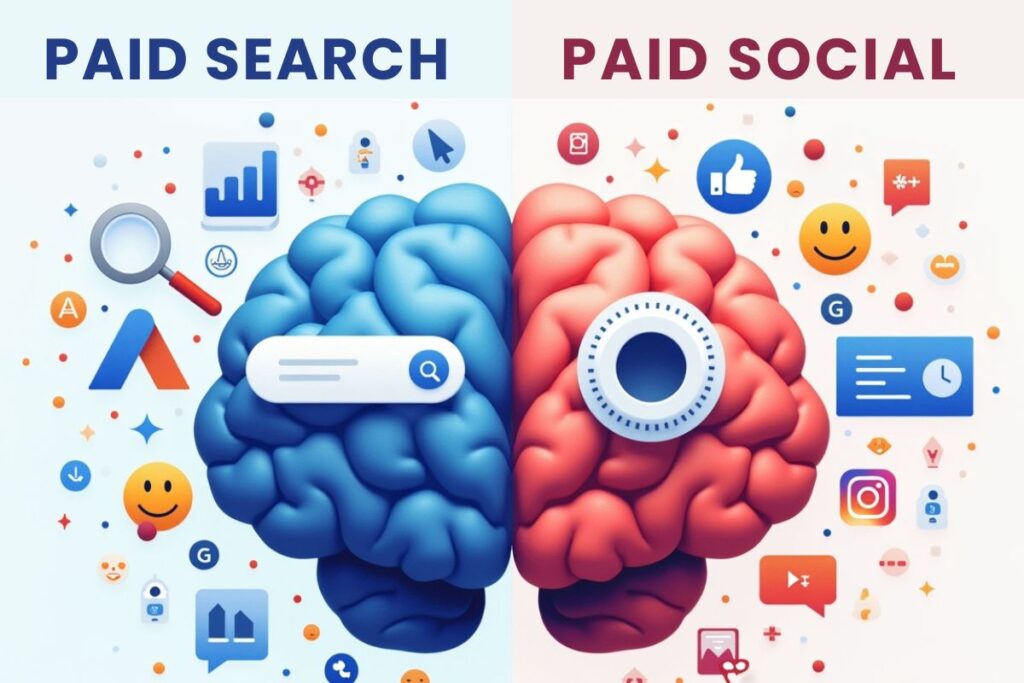
When it comes to PPC advertising, paid search and paid social are two of the most powerful strategies available today. However, businesses don’t have the luxury of an unlimited ad budget. So the real question becomes: Where should I invest my money to get the best return?
Both channels can deliver strong results, but they operate differently in terms of how they reach users, the intent behind those users, the types of ad formats they support, and how they fit into the customer journey. That’s why making the right choice isn’t always straightforward.
In this blog, we’ll break down the key differences between paid search and paid social, how each platform functions, what kind of audience it targets, and when each is most effective. By the end, you’ll have a clear understanding of which strategy aligns better with your marketing goals and which one is the smarter investment for your business.
Paid Social Ads
What is Paid Social?
Paid social advertising involves promoting your brand or content through sponsored campaigns on social media platforms. Unlike organic posts that rely on follower engagement, paid social ensures your message reaches a carefully selected audience even if they’ve never interacted with your brand before.
These ads are shown while users are browsing or scrolling, rather than in response to a search. This makes paid social more disruptive in nature but highly effective for grabbing attention and boosting visibility. Depending on the platform, ads come in various engaging formats. For example:
- Facebook & Instagram: Carousel ads, Stories, Reels, video and image ads
- LinkedIn: Sponsored content and In Mail
- X (formerly Twitter): Promoted tweets
- YouTube: Skippable and non-skippable video ads
What makes paid social powerful is its targeting capabilities. Advertisers can reach users based on demographics, interests, behaviours, job titles, life events, and more making it ideal for precision marketing. Whether you’re launching a new product, raising brand awareness, or engaging niche audiences, paid social is built to get your content in front of the right people at the right time.
What Are You Paying For Paid Social?
In paid social campaigns, you’re investing in reach and engagement, paying primarily for your content to be seen and interacted with. Platforms offer different pricing models such as:
- CPC (Cost Per Click): You’re charged each time someone clicks on your ad.
- CPM (Cost Per Mille): You pay per 1,000 impressions (times your ad is shown).
- CPV (Cost Per View): This model is commonly used in video ads, where you’re billed based on how many users watch a portion of your content.
- CPA (Cost Per Action): You’re charged when a user completes a desired action like signing up or making a purchase.
Essentially, you’re paying for visibility and interaction with a targeted audience. The investment is focused on placing your message in front of people likely to be interested in your brand even if they aren’t searching for it actively.
Paid Search
What is Paid Search Advertising?
Paid search advertising is a strategy where businesses pay to have their ads displayed prominently in search engine results pages (SERPs) typically at the top or alongside organic listings. These ads are triggered when users enter specific keywords or queries into search engines like Google, Bing, or Yahoo, making them a powerful way to connect with users who already have a clear interest or intent.
What sets paid search apart is its alignment with high-intent users actively looking for solutions. Because of this, paid search is considered a highly effective marketing channel, bringing users to your website when they’re already in the decision-making phase.
What Are You Paying For in Paid Search?
The most common pricing model in paid search is Pay-Per-Click (PPC), where you pay only when someone clicks on your ads. This model makes paid search extremely cost-efficient and performance-focused, as the money spent is tied directly to user interaction.
Here’s a breakdown of what you need to pay for in paid search:
- Clicks (CPC – Cost Per Click): You’re charged each time someone clicks your ad. The cost depends on how competitive your chosen keywords are.
- Impressions (CPM – Cost Per Mille): Instead of paying for every click, you can choose to pay only when someone takes a valuable action like filling out a form or making a purchase.
- Conversions (CPA – Cost Per Action): To appear above competitors in search results, advertisers can bid higher and improve their ad quality. A better ad rank gives your ad a top spot, increasing visibility and click chances.
- Premium Ad Placement: If you want your ad to appear on top you’ll need a strong bid and a high-quality ad. Better ads and higher bids help you outrank competitors and grab the most visible spots.
In addition to these, advertisers also invest in advanced targeting options, paying for the ability to reach users based on Keywords and search terms, Geographic location, Device type etc. This precision ensures your ads appear only to the most relevant audience.
Key Differences
1. Ad Formats
Search ads are typically text-based, sometimes enhanced with extensions like site links, call buttons, or product listings. Search ads are designed to be informative and direct, helping users quickly find what they’re looking for.
Paid social offers a much wider variety of visual and multimedia formats including image posts, video ads, carousels, and interactive stories. These formats are designed for visual engagement, storytelling, and emotional appeal. They’re ideal for showcasing products, building brand identity, or creating buzz through visually compelling content.
2. User intent
Paid search is an intent-driven channel often referred to as a “pull” marketing strategy. Users actively type specific queries into search engines because they’re seeking information, products, or services. These users already have a need, and paid search ads appear as relevant solutions.
Paid social, on the other hand, functions as a “push” channel. Ads are served to users while they scroll through social feeds, often without actively looking for anything. This form of advertising taps into user interests, emotions, and behaviors to create demand, rather than responding to it.
3. Duration
Paid search campaigns often deliver immediate, short-term results. Because they target users who are actively searching for something in the moment, you can start seeing traffic and conversions as soon as your ads go live. This makes paid search ideal for time-sensitive promotions, sales, or service-based businesses that rely on instant leads. However, the moment you pause the campaign, the visibility stops
In contrast, paid social campaigns tend to have a longer-lasting brand impact. Even if users don’t convert right away, repeated exposure to visual content can build familiarity over time. Social content can also generate organic shares, comments, and engagement that continue even after the paid budget is spent.
4. Conversion
Paid search typically delivers higher conversion rates and more immediate ROI, especially for campaigns aimed at direct sales or lead generation. On average, search ads convert at approximately 3.75%, compared to around 2.1% for social ads.This difference exists because paid search targets users with clear intent.
In contrast, paid social ads are focused on building long-term brand awareness and shaping customer perception over time. Thus, the conversion impact of paid social is often delayed, as its influence can persist even after the ads have stopped running. Users exposed to your brand on social media may recall your message days or even weeks later.
Ad Spend Strategy Across the Marketing Funnel
If you’re wondering how to divide your ad budget effectively, use this simple guide as a starting point. Each stage of the funnel requires a different focus here’s how you can balance your spend between paid social and paid search for maximum impact:
Stage | Ad Spend | Why |
Awareness | 70% Social / 30% Search | Paid social is better for reaching new audiences and building brand visibility before users begin searching. |
Consideration | 50% Social / 50% Search | Paid social builds interest & Paid search catches people actively looking. |
Conversion | 30% Social / 70% Search | Paid search targets users with high intent, making it more effective for driving immediate actions or purchases. |
Loyalty | 60% Social / 40% Search | Paid Social keeps your brand top of mind through remarketing and community engagement.
|
Conclusion
Both paid search and paid social are powerful in their own ways and ideally, the most effective approach often involves using both together to guide potential customers through different stages of the funnel from awareness to conversion
However, if you need to choose just one, let your marketing goals guide you. If you’re aiming for quick results and conversions, invest in paid search. But if you’re focused on long-term brand building and audience engagement, paid social is the right choice for you.
We hope this breakdown has helped you understand which strategy best fits your business needs. Whether you need help with paid search, paid social, or both, Supersoft Digiads is here to help you maximize the return on investment for your company